|
In digital marketing, the query "buy TikTok followers" has become not only a phrase but an entire service niche. It means external account growth through legal or semi-legal mechanisms, from targeted promotion to follower packages from agencies. In practice, businesses try to accelerate growth, improve brand trust, and expand reach. The key is to separate a fast numeric increase from sustainable community building.
From 2022 to 2026, TikTok has become a market where organic starts for new brands are harder due to saturation. Users are used to regular short videos, and algorithms now evaluate both creativity and new follower behavior signals. In such an environment, a new account without investment can take months to scale, so companies look for tools that warm the profile fast. This is where demand for follower purchases appears as a tactical instrument rather than a final goal.
At the beginning, it helps to define three goals of purchased followers. The first is psychological: a bigger profile appears more active to newcomers. The second is technical: more followers create more reactions and stronger behavioral signals. The third is commercial: quick access to a segment for future retargeting and funneling.
If you are starting, open a practical service list first: https://fexsmm.com/s/tiktok/tiktok-subscribers. This is often useful for comparing service packages and deployment formats.
TikTok follower analytics: entrepreneur plans audience growth through marketing strategy

|
- ➔ How TikTok interprets sudden follower spikes
- ➔ Risks from fake or bot followers for business growth
- ➔ Methods to calculate ROI in follower campaigns
- ➔ Which metrics matter most: ER, watch time, lead conversion
- ➔ Strategy to move from purchased followers to organic growth
- ➔ Safe combination of TikTok Ads and external follower mechanics
- ➔ Why Russia, United States, and India grow differently in this market
Early social growth came from manual follows and community exchanges. Later, automation brought follower trade services and bot growth tools. As markets matured, marketplaces and lead exchanges added package-based growth with better tracking.
Typical user segments:
- ➔ Startups and personal brands
- ➔ Small and mid-size businesses with limited budget
- ➔ Educators and micro-influencers
- ➔ Marketing agencies testing campaign hypotheses
Startups use it to create early social proof. Local business teams use it to increase recognition in crowded categories. Creators use it as a bridge to cross the first trust threshold. Agencies use it to test formats before increasing spend.
Benefits exist when treated as support, not a replacement:
- ➔ Faster trust building for new pages
- ➔ Faster testing of content and offers
- ➔ Better initial reach of first posts
- ➔ Better ad seeding and retargeting
- ➔ Time savings in the first 30-60 days
Follower count does not create sales by itself. It mainly accelerates the top of funnel; conversion still depends on content, service scripts, and operational workflow.
The main risk is mistaking follower growth for business growth. In weaker setups, low-quality followers reduce reach and damage authenticity. Reputation risk appears when users see many follows without comments and saves. Algorithmic risk is abnormal spikes triggering quality flags. Compliance risk is using providers that violate platform rules, resulting in penalties.
- ➔ Choosing low-transparency providers
- ➔ Buying extremely cheap packages with bot traffic
- ➔ Not running quality content in the first 14 days
- ➔ Measuring only total followers and ignoring ER/retention
- ➔ Weak moderation of comments and private messages
If followers are artificially generated, analytics can look good while leads stay weak.
All three markets use similar mechanisms, but execution differs. In Russia, price sensitivity and speed are high, so compact package tests are common. In the United States, purchased followers are often tied to aggressive launch and creator collaborations. In India, language-driven trends and regional formats strongly shape campaign performance.
- ➔ Week 1: audit profile, profile, and funnel
- ➔ Week 2: launch controlled package with moderate pace
- ➔ Weeks 3-4: publish 1-3 videos daily, test hooks and CTAs
- ➔ Weeks 5-6: monitor ER, watch time, profile conversions
- ➔ Weeks 7-8: scale only formats with positive organic lift
Avoid optimizing for metric spikes. Followers and engagement must move together.
- ➔ CAC by follower = spend / new followers
- ➔ CPA lead = campaign spend / leads from profile
- ➔ ROI = (revenue from leads - ad spend) / campaign spend
- ➔ LTV / CAC ratio checks long-term sustainability
- ➔ Repeat purchase rates in 30 and 90 days
A low CAC follower can still be wrong if lead CPA exceeds margin.
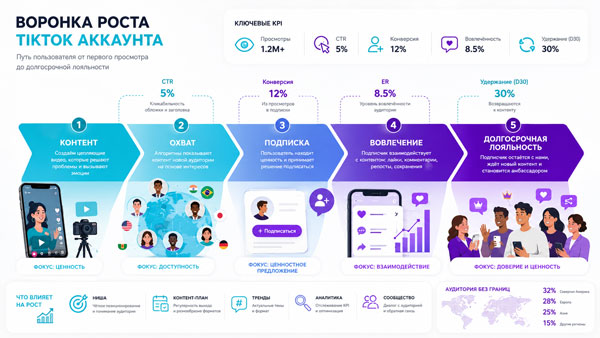
Infographic of TikTok follower growth funnel from content to loyalty and repeat sales
|
Use official platform guidance to stay aligned with policies.
TikTok Support Center (Russian)
TikTok for Business (Russian page)
The principle is clear: artificial activity without quality content is unstable.
Likely shifts by 2027:
- ➔ Better quality verification and transparency
- ➔ More integration with CRM and ad ecosystems
- ➔ Stricter controls against synthetic interaction networks
The market will move from one-time volume purchases to quality-first hybrid growth and retention systems.
Buying followers remains useful for the launch phase when handled by a clear strategy. It is not a substitute for core marketing. Use it as a starting layer, then build consistent content, engagement workflows, and conversion systems. Done correctly, it can produce not only a sharp dashboard snapshot but durable business results that persist beyond the first surge.
Most teams fail by treating follower purchase as an end point. In reality, it is only the first phase, and the next 90 days is where quality is validated. A practical rule is to review not only growth, but engagement quality each week. A useful matrix is: high growth + high ER = scale; high growth + low ER = inspect source quality; stable ER + weak growth = strengthen content and offer mix.
An efficient weekly checklist is:
- ➔ Share rate: % new followers using follow actions
- ➔ ER by creative type, with saves and shares
- ➔ Average view time in the first 30 days
- ➔ Qualified link clicks and direct messages
- ➔ Lead rate and meeting conversion downstream
If the first four checks stay stable and lead conversion falls, the issue is often CTA clarity or sales reply quality, not follower quality.
When sales and marketing disagree, vanity metrics can dominate. Put a single dashboard: followers, ER, leads, CPA, LTV, and source-of-growth tags (organic, paid, purchased package, collaboration). This prevents over-optimization on one signal and keeps teams aligned around business outcomes. Clear governance improves reporting confidence and makes decisions easier when campaign performance diverges between regions.
|